





Connecting the Dots with Brisa Flow
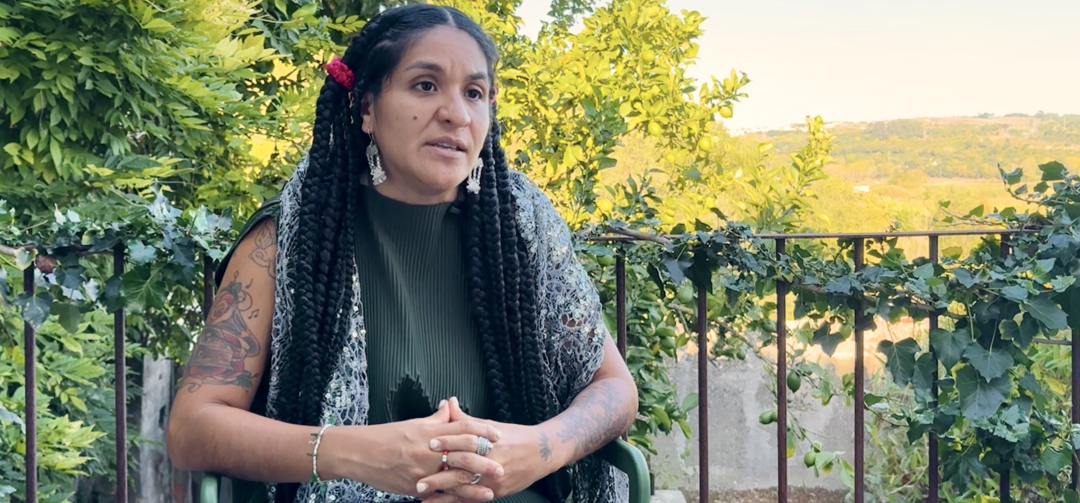
A conversation with the Mapuche rapper, singer, and producer about ancestry, exile, and the sonic territories where Indigenous memory refuses to be silenced.
Brisa de la Cordillera, a Mapuche artist, is the daughter of Chilean artisans who left the country in 1987 during the Pinochet dictatorship. She grew up in Brazil, in a suburb of Belo Horizonte, in Minas Gerais, where she began her artistic journey.
She is a rapper, singer, songwriter, producer, and educator. Her work traces a singular path that spans rap, ancestral chants, jazz, electronic music, and Andean music. She has released three albums: “Newen,” “Selvagem como o vento,” and “Janequeo.” She was the first Indigenous artist to perform at Lollapalooza.
We spoke with her during her visit to Portugal, where she participated in FOLIO—the Óbidos International Literary Festival—and where she completed an artist residency organized by the Terra Batida platform, which has been inviting Brazilian Indigenous artists to explore the politics of memory and erasure that permeate the collections held in museums and archives across Portugal.
Dive into Brisa Flow’s artistic vision by visiting her official Youtube and Spotify accounts. You can also follow Brisa’s official Instagram account for the latest news.
Play the video version below (English subtitles available), or scroll down for the podcast version (dubbed in English) and for the transcript (in English).
CONNECTING THE DOTS – PODCAST
Are you a podcast fan? Make sure you subscribe to the podcast version of our Connecting the Dots series here.
ENGLISH TRANSCRIPT (TRANSLATION)
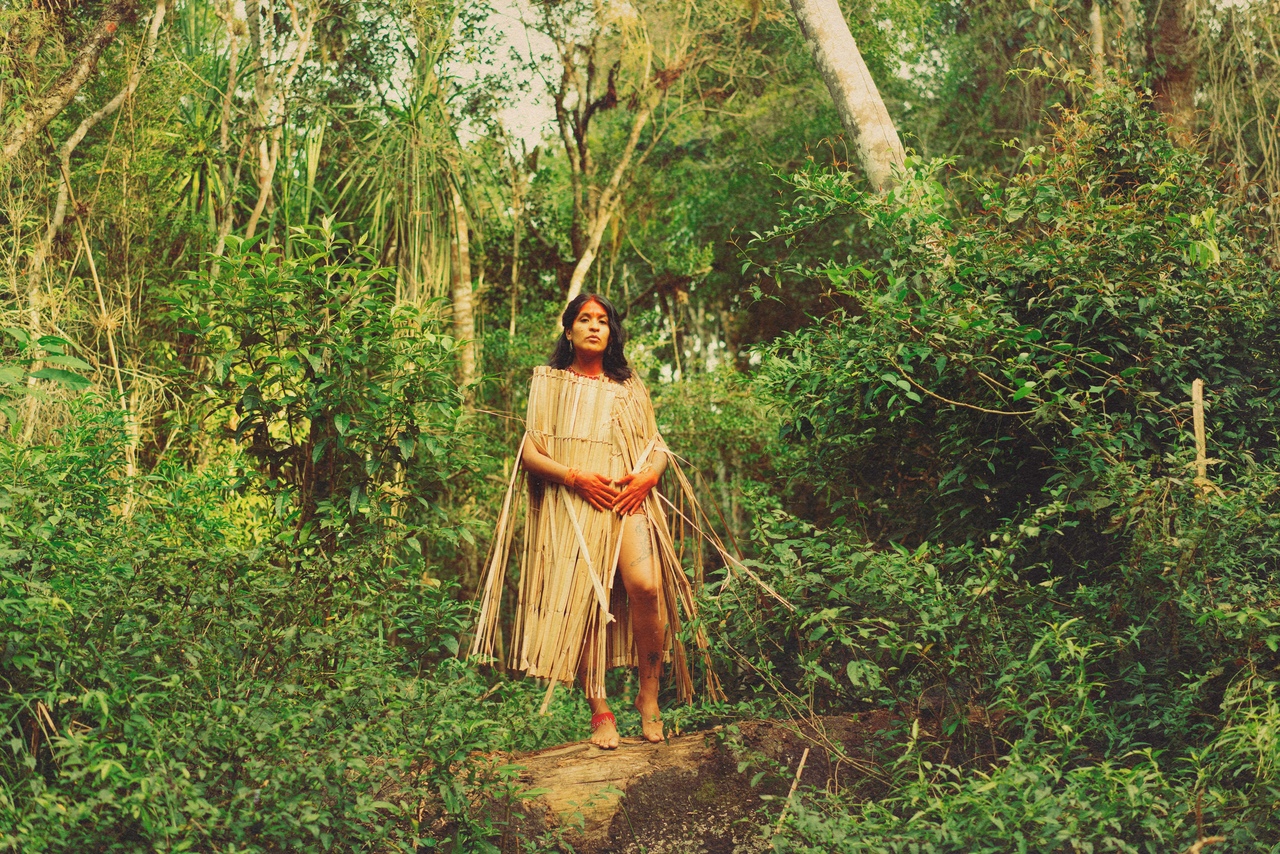
Brisa-Flow-by-Camila-Sánchez-03
Credit: Camila Sanchez
EPISTEMICIDE | HIP-HOP AND HISTORY
I’ve been working with hip-hop for many years. The music of Indigenous Peoples, as well as hip-hop — which comes from Black, Jamaican culture — are deeply embedded in the education of many people, of many children in Brazil. When I went to study Music as an undergraduate, I realized how profoundly racist the curriculum is. There’s a massive erasure within it. For me, that was incredibly violent. And then I understood that this is what epistemicide means. How can teachers be trained properly, if their curriculum lacks these stories, these songs? If it lacks respect, and it lacks memory?
For me, hip-hop was like a great history lesson, as someone coming of age, as a teenager. I could identify in many ways with “Sobrevivendo no Inferno” (Surviving in Hell), which is a 1997 album by Racionais. When I first came across lyrics by Racionais, it felt like I was reading a history book.
When I decided to pursue an academic degree, many years later, I wrote a song with my partner Ian Wapichana, and we wanted to talk about this form of epistemicide. About how pervasive it is. And about the ways in which hip-hop has provided us with a different story. The song was actually called “Rape, Suicide, and Murder.” And that was the name of the song up until I released my album, “Janequeo.”
In the lyrics to the song “Epistemicídio” we talk about the trauma of language, the trauma of the word. We say: “Far from the Andes, nothing is as it was before // from the Cordillera, nothing is as it was before. // Breeze driftin’ on by // It’s a new life, it’s a new day for me. // A prayer from Nina to start my day in this made-up country, // where the cross, the crown, and the State want to colonize the native. // Their culture, their beliefs, their language, // and that makes you think that these belong in the past, through a manipulation of subjectivity and of meaning. // You have to stay tuned to the codes, to the languages, // so as not to be captured by the margins. // They’re on the hunt, they’re on the hunt, // to retain their power // through TV or through the algorithm, // and it’s clear that genocide is responsible for the high rate of suicide and murder.”
That’s why the song was called “Rape, Suicide, and Murder” — those are the things that an imposed language brought with it, the consequences that were silenced and that went unspoken. But then we thought: “Who’s going to want to listen to a song called ‘Rape, Suicide, and Murder’?” Nobody wants to see the naked truth. That’s why we ended up with the title “Epistemicide,” which is the academic term for all of this.
And it worked out really well. We made a video at the ATL, the Indigenous Peoples’ Free Land Camp, where we tried to document how we’re still fighting against epistemicide. And I believe that hip-hop should continue to play this role of bringing forth the historical, social, and political truth that runs through our bodies.
BREAKING DOWN BORDERS | A MAPUCHE IN MINAS GERAIS
I grew up in Sabará, which is right next to Belo Horizonte. There’s a very violent loneliness in that experience. Being far away, not being able to participate in the rituals, not being able to have a “rehue.” But I believe that the Ngen — the Ngen-ko; the Ngen Newen spirit of strength; the Ngen spirit of water (my family comes from the rivers), the Ngen-Leufu — I believe that all of these have accompanied me. Kürüf, the Wind, the name my mother gave me, Brisa de la Cordillera (Breeze of the Mountain Range).
I grew up facing the mountains, so I also believe that I continued to be protected by the Ngen, in the place where I grew up. The spirit of the mountain at the end of Rua Espanha (Spain Street), where I lived. The neighborhood where I grew up is called Nações Unidas (United Nations). All the streets in that neighbourhood are named after countries. And, coincidentally or not, I lived on Spain Street. And so this was a question from the start: “Mom, isn’t Spain the country that colonized Chile?” And so my mother taught me all about the historical context.
As much as I understood my Indigenous heritage as a place of erasure, I also felt that a culture was present within my home. So, my first border-crossing was the journey between home and school, which separated two different worlds. I was an Indigenous child, born to a family of Chileans who faced xenophobia. Xenophobia towards Indigenous Peoples of the Andes isn’t called racism in Brazil. But it is totally racist, because it’s linked to the physical traits of Indigenous Peoples who come from the south, from Chile, Bolivia, and Peru. And this raises so many questions, it says so much about erasure, about how far people still are from understanding the true historical context of our continent.
Growing up, that was really tough. But at the same time, my mother always braided my hair. That was very important. I listened to a lot of music. I’ve always been close to the Ngen, to the power of the flutes. I’ve been playing the ocarina since I was a child. Since I was a child, I’ve had a cascahuilla of the waters. We have different kinds of cascahuillas, depending on your clan, on whether your clan is from the river, whether your clan is Leufu, whether your clan is Lafkenche, from the sea. And I’ve always maintained a very strong connection to the rivers in Brazil. So I feel like a “wandering” body, as I like to say. But I feel like a Mapuche, wherever I go.
And not just a Mapuche. I feel like someone from Minas Gerais, too. Because Minas Gerais also has its Indigenous cultures, which are present in the rivers there, and which are also experiencing an absurd genocide caused by mining. And I believe that this force is still present in the intellectual culture of Minas Gerais, which is very rich musically, and which shaped me, too.
ANCESTRAL FUTURE | TIME AS A SPIRAL
There was a time when the press called me a leading figure of Indigenous futurism, because I was the first Indigenous person to perform at Lollapalooza. I think a lot of it stems from the phrase “ancestral future.” Ailton Krenak says that the future is ancestral. I believe there is no future. The future is always a product of anxiety. And tomorrow, theoretically, is always today. So, in this non-linear spiral of time, where many things repeat themselves, it’s as if the future is the past. We’re trying to imagine a possible future, but that possibility will only exist once we are able to really tell what has happened in the past, in order to understand what’s going on in the present.
Right now, Europe is experiencing a heatwave. And in Brazil, back home, we’re seeing heavy rains in the Atlantic Forest. Cold, windy weather. So, that future doesn’t exist. What we’re seeing is perhaps the end of the human species. And who will survive this? What are the technological plans for this futurism? Which Peoples will benefit from technology? And who will foot the bill for the climate crisis? That is what environmental racism is, and it’s already happening.
I’m here to talk about the future, but not in such a technological way. Perhaps in a more analog way. And I’m someone who likes to use cell phones, synthesizers. I’ve mastered the code of whiteness. I come and go. I switch masks easily with this technology. But I’ve been increasingly moving in an analog direction, because as I’ve accessed these technological worlds, I’ve become aware of how extremely harmful they are. The world of artificial intelligence, the world of mobile devices. And I have seen how important it is to classify that future as a failed future.
MARICHIWEU | WE WILL WIN 10 TIMES OVER
I believe I am a Weichafe. Even though I didn’t grow up in the territory with a Weichafe ritual, I feel like I went through a Weichafe warrior ritual in the city, having to survive in São Paulo with a newborn baby, trying to find a job and continuing the story of my ancestors, which is also a story about territory.
My mother didn’t have a dime to her name when she arrived in Brazil. She was pregnant with me, and was completely broke. She sat in Praça da Sé. Then someone came by, gave her some money, and she was able to make it to Belo Horizonte, Minas Gerais, where I grew up. And that’s where she became a well-known artisan.
My parents are silversmiths. For the Mapuche, silver is an ancestral heritage that keeps reaching us across generations. My father didn’t train as a silversmith within a Mapuche community. He inherited the gift of silver in his DNA, in his spirit. And he brought that to Brazil. And I really like bringing that forth, as well. I’ve always been surrounded by silver. In my parents’ workshop, singing and playing there, while my father did his handiwork.
For me, “Marichiweu, we will win 10,000 times over,” is a title I used because we are always defeating colonialism. Even when you’re growing up in the outskirts of Minas Gerais, you’re still defeating colonialism. Minas Gerais has been ravaged by mining. If you take a trip around Minas, you see mountains cut open. And there’s the current technology, drones that fly overhead to spot ore, to spot gold, so that companies can gain access to these territories. Access for companies is very easy, all over Brazil. And the same thing happens in Chile.
And the Mapuche struggle faces extreme persecution. We recently learned about the shocking story of Julia Chuñil. She was a Mapuche woman who went missing, I believe for more than eight months. And she was burned alive at the behest of a businessman in Chile. The Mapuche who oppose this are tortured, they become political prisoners, they are considered terrorists. That’s absurd, to claim that someone who defends their territory and its ecosystem is a terrorist. And this is what is happening right now. The police is inside Mapuche territory in Chile, as we speak.
This is happening right at this moment, with the Pataxós, in Brazil. Nega Pataxó was murdered. Pataxó youths were murdered, too. In fact, one of them was a rap fan and used to rap too. We also saw how Brayan was murdered. He was mysteriously found dead, run over on Bandeirantes Avenue, near the Guarani territory, while we were protesting against PEC 490.
So repression against Indigenous Peoples continues to this day. And this repression is always tied to land issues. I believe this is an ancient struggle. But at the same time, we often talk about this struggle in a very discouraging way. So much so that Indigenous youth have the highest suicide rate. That’s a reflection, as I said, of epistemicide. It’s a reflection of how we’re dealing with impoverishment, in a way that offers no perspective. So, hip-hop, for example, can become a perspective. Access to cinema can become a perspective. This is how our young people have been finding ways to escape this poverty, this impoverishment.
So, I’ve been thinking that “Marichiweu” is a word that embodies that strength. Leftraro defeated the Spanish, and we will defeat them 10,000 times over. Janequeo wasn’t captured. Galvarino forged new iron fists. And we have Bartolina Sisa, and Túpac Amaru, and Chicão, and Tuíra, and Jaider Esbell, and so on. We keep many of our warriors alive, even if they are dead. They stay alive within us, in our Weichafe spirits.
So, it’s important to also speak about those times we won. When we talk about this war, it can feel like we’re losing all the time. Because it really is cruel, the way we’ve been murdered. But the fact that we are also living seeds, that we can continue the struggle, this also shows that Marichiweu – we will win ten times over. That’s what motivates us to keep fighting.


Share

Connecting the Dots with Brisa Flow
A conversation with the Mapuche rapper, singer, and producer about ancestry, exile, and the sonic territories where Indigenous memory refuses to be silenced.
Brisa de la Cordillera, a Mapuche artist, is the daughter of Chilean artisans who left the country in 1987 during the Pinochet dictatorship. She grew up in Brazil, in a suburb of Belo Horizonte, in Minas Gerais, where she began her artistic journey.
She is a rapper, singer, songwriter, producer, and educator. Her work traces a singular path that spans rap, ancestral chants, jazz, electronic music, and Andean music. She has released three albums: “Newen,” “Selvagem como o vento,” and “Janequeo.” She was the first Indigenous artist to perform at Lollapalooza.
We spoke with her during her visit to Portugal, where she participated in FOLIO—the Óbidos International Literary Festival—and where she completed an artist residency organized by the Terra Batida platform, which has been inviting Brazilian Indigenous artists to explore the politics of memory and erasure that permeate the collections held in museums and archives across Portugal.
Dive into Brisa Flow’s artistic vision by visiting her official Youtube and Spotify accounts. You can also follow Brisa’s official Instagram account for the latest news.
Play the video version below (English subtitles available), or scroll down for the podcast version (dubbed in English) and for the transcript (in English).
CONNECTING THE DOTS – PODCAST
Are you a podcast fan? Make sure you subscribe to the podcast version of our Connecting the Dots series here.
ENGLISH TRANSCRIPT (TRANSLATION)
Brisa-Flow-by-Camila-Sánchez-03
Credit: Camila Sanchez
EPISTEMICIDE | HIP-HOP AND HISTORY
I’ve been working with hip-hop for many years. The music of Indigenous Peoples, as well as hip-hop — which comes from Black, Jamaican culture — are deeply embedded in the education of many people, of many children in Brazil. When I went to study Music as an undergraduate, I realized how profoundly racist the curriculum is. There’s a massive erasure within it. For me, that was incredibly violent. And then I understood that this is what epistemicide means. How can teachers be trained properly, if their curriculum lacks these stories, these songs? If it lacks respect, and it lacks memory?
For me, hip-hop was like a great history lesson, as someone coming of age, as a teenager. I could identify in many ways with “Sobrevivendo no Inferno” (Surviving in Hell), which is a 1997 album by Racionais. When I first came across lyrics by Racionais, it felt like I was reading a history book.
When I decided to pursue an academic degree, many years later, I wrote a song with my partner Ian Wapichana, and we wanted to talk about this form of epistemicide. About how pervasive it is. And about the ways in which hip-hop has provided us with a different story. The song was actually called “Rape, Suicide, and Murder.” And that was the name of the song up until I released my album, “Janequeo.”
In the lyrics to the song “Epistemicídio” we talk about the trauma of language, the trauma of the word. We say: “Far from the Andes, nothing is as it was before // from the Cordillera, nothing is as it was before. // Breeze driftin’ on by // It’s a new life, it’s a new day for me. // A prayer from Nina to start my day in this made-up country, // where the cross, the crown, and the State want to colonize the native. // Their culture, their beliefs, their language, // and that makes you think that these belong in the past, through a manipulation of subjectivity and of meaning. // You have to stay tuned to the codes, to the languages, // so as not to be captured by the margins. // They’re on the hunt, they’re on the hunt, // to retain their power // through TV or through the algorithm, // and it’s clear that genocide is responsible for the high rate of suicide and murder.”
That’s why the song was called “Rape, Suicide, and Murder” — those are the things that an imposed language brought with it, the consequences that were silenced and that went unspoken. But then we thought: “Who’s going to want to listen to a song called ‘Rape, Suicide, and Murder’?” Nobody wants to see the naked truth. That’s why we ended up with the title “Epistemicide,” which is the academic term for all of this.
And it worked out really well. We made a video at the ATL, the Indigenous Peoples’ Free Land Camp, where we tried to document how we’re still fighting against epistemicide. And I believe that hip-hop should continue to play this role of bringing forth the historical, social, and political truth that runs through our bodies.
BREAKING DOWN BORDERS | A MAPUCHE IN MINAS GERAIS
I grew up in Sabará, which is right next to Belo Horizonte. There’s a very violent loneliness in that experience. Being far away, not being able to participate in the rituals, not being able to have a “rehue.” But I believe that the Ngen — the Ngen-ko; the Ngen Newen spirit of strength; the Ngen spirit of water (my family comes from the rivers), the Ngen-Leufu — I believe that all of these have accompanied me. Kürüf, the Wind, the name my mother gave me, Brisa de la Cordillera (Breeze of the Mountain Range).
I grew up facing the mountains, so I also believe that I continued to be protected by the Ngen, in the place where I grew up. The spirit of the mountain at the end of Rua Espanha (Spain Street), where I lived. The neighborhood where I grew up is called Nações Unidas (United Nations). All the streets in that neighbourhood are named after countries. And, coincidentally or not, I lived on Spain Street. And so this was a question from the start: “Mom, isn’t Spain the country that colonized Chile?” And so my mother taught me all about the historical context.
As much as I understood my Indigenous heritage as a place of erasure, I also felt that a culture was present within my home. So, my first border-crossing was the journey between home and school, which separated two different worlds. I was an Indigenous child, born to a family of Chileans who faced xenophobia. Xenophobia towards Indigenous Peoples of the Andes isn’t called racism in Brazil. But it is totally racist, because it’s linked to the physical traits of Indigenous Peoples who come from the south, from Chile, Bolivia, and Peru. And this raises so many questions, it says so much about erasure, about how far people still are from understanding the true historical context of our continent.
Growing up, that was really tough. But at the same time, my mother always braided my hair. That was very important. I listened to a lot of music. I’ve always been close to the Ngen, to the power of the flutes. I’ve been playing the ocarina since I was a child. Since I was a child, I’ve had a cascahuilla of the waters. We have different kinds of cascahuillas, depending on your clan, on whether your clan is from the river, whether your clan is Leufu, whether your clan is Lafkenche, from the sea. And I’ve always maintained a very strong connection to the rivers in Brazil. So I feel like a “wandering” body, as I like to say. But I feel like a Mapuche, wherever I go.
And not just a Mapuche. I feel like someone from Minas Gerais, too. Because Minas Gerais also has its Indigenous cultures, which are present in the rivers there, and which are also experiencing an absurd genocide caused by mining. And I believe that this force is still present in the intellectual culture of Minas Gerais, which is very rich musically, and which shaped me, too.
ANCESTRAL FUTURE | TIME AS A SPIRAL
There was a time when the press called me a leading figure of Indigenous futurism, because I was the first Indigenous person to perform at Lollapalooza. I think a lot of it stems from the phrase “ancestral future.” Ailton Krenak says that the future is ancestral. I believe there is no future. The future is always a product of anxiety. And tomorrow, theoretically, is always today. So, in this non-linear spiral of time, where many things repeat themselves, it’s as if the future is the past. We’re trying to imagine a possible future, but that possibility will only exist once we are able to really tell what has happened in the past, in order to understand what’s going on in the present.
Right now, Europe is experiencing a heatwave. And in Brazil, back home, we’re seeing heavy rains in the Atlantic Forest. Cold, windy weather. So, that future doesn’t exist. What we’re seeing is perhaps the end of the human species. And who will survive this? What are the technological plans for this futurism? Which Peoples will benefit from technology? And who will foot the bill for the climate crisis? That is what environmental racism is, and it’s already happening.
I’m here to talk about the future, but not in such a technological way. Perhaps in a more analog way. And I’m someone who likes to use cell phones, synthesizers. I’ve mastered the code of whiteness. I come and go. I switch masks easily with this technology. But I’ve been increasingly moving in an analog direction, because as I’ve accessed these technological worlds, I’ve become aware of how extremely harmful they are. The world of artificial intelligence, the world of mobile devices. And I have seen how important it is to classify that future as a failed future.
MARICHIWEU | WE WILL WIN 10 TIMES OVER
I believe I am a Weichafe. Even though I didn’t grow up in the territory with a Weichafe ritual, I feel like I went through a Weichafe warrior ritual in the city, having to survive in São Paulo with a newborn baby, trying to find a job and continuing the story of my ancestors, which is also a story about territory.
My mother didn’t have a dime to her name when she arrived in Brazil. She was pregnant with me, and was completely broke. She sat in Praça da Sé. Then someone came by, gave her some money, and she was able to make it to Belo Horizonte, Minas Gerais, where I grew up. And that’s where she became a well-known artisan.
My parents are silversmiths. For the Mapuche, silver is an ancestral heritage that keeps reaching us across generations. My father didn’t train as a silversmith within a Mapuche community. He inherited the gift of silver in his DNA, in his spirit. And he brought that to Brazil. And I really like bringing that forth, as well. I’ve always been surrounded by silver. In my parents’ workshop, singing and playing there, while my father did his handiwork.
For me, “Marichiweu, we will win 10,000 times over,” is a title I used because we are always defeating colonialism. Even when you’re growing up in the outskirts of Minas Gerais, you’re still defeating colonialism. Minas Gerais has been ravaged by mining. If you take a trip around Minas, you see mountains cut open. And there’s the current technology, drones that fly overhead to spot ore, to spot gold, so that companies can gain access to these territories. Access for companies is very easy, all over Brazil. And the same thing happens in Chile.
And the Mapuche struggle faces extreme persecution. We recently learned about the shocking story of Julia Chuñil. She was a Mapuche woman who went missing, I believe for more than eight months. And she was burned alive at the behest of a businessman in Chile. The Mapuche who oppose this are tortured, they become political prisoners, they are considered terrorists. That’s absurd, to claim that someone who defends their territory and its ecosystem is a terrorist. And this is what is happening right now. The police is inside Mapuche territory in Chile, as we speak.
This is happening right at this moment, with the Pataxós, in Brazil. Nega Pataxó was murdered. Pataxó youths were murdered, too. In fact, one of them was a rap fan and used to rap too. We also saw how Brayan was murdered. He was mysteriously found dead, run over on Bandeirantes Avenue, near the Guarani territory, while we were protesting against PEC 490.
So repression against Indigenous Peoples continues to this day. And this repression is always tied to land issues. I believe this is an ancient struggle. But at the same time, we often talk about this struggle in a very discouraging way. So much so that Indigenous youth have the highest suicide rate. That’s a reflection, as I said, of epistemicide. It’s a reflection of how we’re dealing with impoverishment, in a way that offers no perspective. So, hip-hop, for example, can become a perspective. Access to cinema can become a perspective. This is how our young people have been finding ways to escape this poverty, this impoverishment.
So, I’ve been thinking that “Marichiweu” is a word that embodies that strength. Leftraro defeated the Spanish, and we will defeat them 10,000 times over. Janequeo wasn’t captured. Galvarino forged new iron fists. And we have Bartolina Sisa, and Túpac Amaru, and Chicão, and Tuíra, and Jaider Esbell, and so on. We keep many of our warriors alive, even if they are dead. They stay alive within us, in our Weichafe spirits.
So, it’s important to also speak about those times we won. When we talk about this war, it can feel like we’re losing all the time. Because it really is cruel, the way we’ve been murdered. But the fact that we are also living seeds, that we can continue the struggle, this also shows that Marichiweu – we will win ten times over. That’s what motivates us to keep fighting.
Share


