





Grassroots organizations
Recognizing that communities hold deep wisdom about their needs and solutions, we serve our partners through institutional support and project-specific funding. This approach helps strenghten organizations’ capacity to create lasting change in their communities and territories. Our support is grounded in flexible, multi-year funding that enables organizations to focus on their long-term vision. Our commitment is founded on honest dialogue and mutual learning, acknowledging that genuine partnership requires time, trust, and respect for indigenous leadership.
Our partnerships develop organically through various pathways: referrals from existing partners, open application cycles we organize, and connections that emerge naturally through our network. However, we do not review unsolicited proposals.
Grassroots organizations
Recognizing that communities hold deep wisdom about their needs and solutions, we serve our partners through institutional support and project-specific funding. This approach helps strenghten organizations’ capacity to create lasting change in their communities and territories. Our support is grounded in flexible, multi-year funding that enables organizations to focus on their long-term vision. Our commitment is founded on honest dialogue and mutual learning, acknowledging that genuine partnership requires time, trust, and respect for indigenous leadership.
Our partnerships develop organically through various pathways: referrals from existing partners, open application cycles we organize, and connections that emerge naturally through our network. We do not review unsolicited proposals.
The Batwa were the original inhabitants of the equatorial forests in Africa’s Great Lakes region. As hunter-gatherers living in harmony with their environment for millennia, they developed sophisticated knowledge of forest ecosystems and maintained deep spiritual connections to their ancestral lands. However, since the 1960s, systematic displacement through encroachment, deforestation, and forced and violent evictions for “conservation” projects has devastated their traditional way of life. Without compensation or alternatives, many Batwa now live in extreme poverty, facing discrimination, lack of access to basic services, and the risk of cultural extinction. Yet across the region, Batwa communities demonstrate remarkable resilience.
Nothing Found
The Endorois have been the traditional custodians of Lake Bogoria and the Siracho Range in Kenya for over half a millennium. This region holds profound spiritual and cultural significance for their community. Their deep connection to the land and extensive Indigenous knowledge systems have been vital to preserving biodiversity and maintaining harmony for generations. However, in 1973, the Endorois faced forced displacement from their ancestral lands without consultation or consent to create the Lake Bogoria National Reserve. Despite a landmark 2010 African Commission ruling declaring their eviction illegal, implementation of justice remains limited. This displacement, combined with climate change impacts, threatens not only their physical well-being but their entire cultural fabric and spiritual identity.
Nothing Found
The Krahô’s approach offers powerful lessons in Indigenous self-determination: they have developed their monitoring methodology based on ancestral practices of walking and observing their territory, adapted to address contemporary threats from agribusiness expansion, illegal extraction, and institutional instability. Their work safeguards one of the largest continuous areas of Cerrado—a biome whose waters sustain the Amazon itself—while strengthening cultural continuity and community cohesion.
Nothing Found
Nothing Found
The Karipuna people inhabit a 153,000-hectare Indigenous territory in Rondônia, bordering Porto Velho, Nova Mamoré, and Guajará-Mirim. After facing near extinction from disease during first contact in the 1970s, they have demonstrated remarkable resilience in protecting their territory and culture. The Karipuna maintain a profound spiritual connection with their forest, viewing it as a mother they must protect. Their territory also shelters groups living in voluntary isolation, adding to their responsibility as forest guardians. Their traditional practices are intrinsically linked to forest preservation—they depend on its resources for food, medicine, and cultural activities. Community members practice sustainable resource management, asking permission before harvesting and taking only what they will consume. This reflects their deep understanding of ecological balance and traditional knowledge systems. However, their territory faces severe threats. The Karipuna Indigenous Territory ranks among Brazil’s most deforested Indigenous lands, with deforestation rates significantly increasing since 2018. Nearly one-third of their territory is threatened by invasions from illegal loggers and land grabbers, while surrounding areas have been cleared for cattle ranching. Despite these pressures, the Karipuna continue their role as forest guardians, fighting to preserve both their cultural heritage and one of the Amazon’s critical ecosystems through their traditional knowledge and active territorial defense.
Nothing Found
Nothing Found
Each of these initiatives stands as a powerful testament to community-led solutions: in the Sierra Nevada de Santa Marta, the Narakajmanta reveal the sophistication of their ancestral water management systems, essential for climate adaptation. In Lovongai, twelve clans preserve irreplaceable knowledge of integrated land and sea stewardship through innovative documentation work. In the Ecuadorian Amazon, Indigenous patrols protect over a million hectares of rainforest, demonstrating the effectiveness of traditional territorial defense strategies. In Bismarck and Cordova, communities reclaim and strengthen millennial health and food practices, rekindling their connection to wisdom that sustained their peoples’ wellbeing for generations. In North Kivu, Indigenous women’s organizations address critical health and safety challenges, with Focus Droits et Accès advancing menstrual and reproductive health and dignity for Batwa women and girls, while APEDH empowers the Kumu community through holistic approaches to combat gender-based violence and promote sexual and reproductive health rights.
Grants,Grassroots Organizations,Humankind and Nature,Other Indigenous-led Partnerships,Partnerships
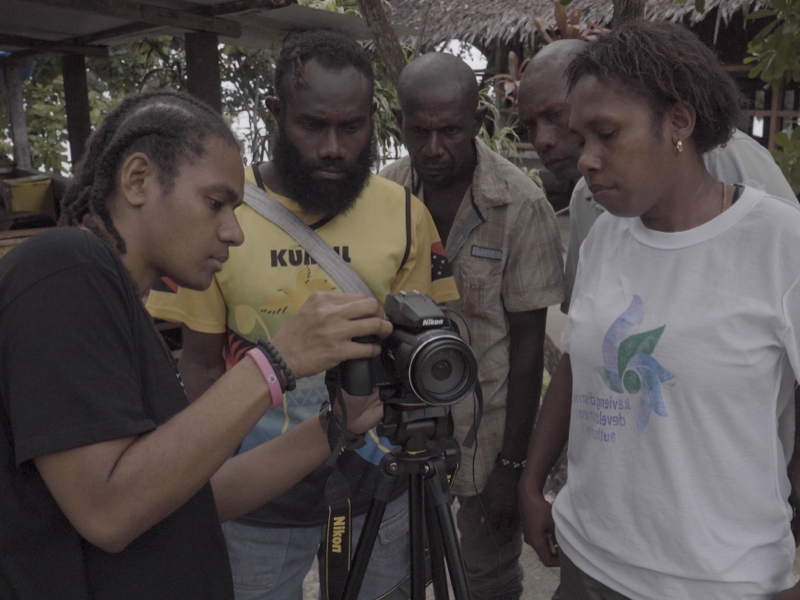
Lovongai Island Green Belt: Traditional Land and Sea Management By and For the 12 Clans, Papua New Guinea
Grant to create evidence-based storytelling that enhances traditional conservation practices, proves land destruction by read more


